
by Nomad
 When people say they believe every word of the Bible, they may not know very much about the history of the sacred text they claim as the direct word of God.
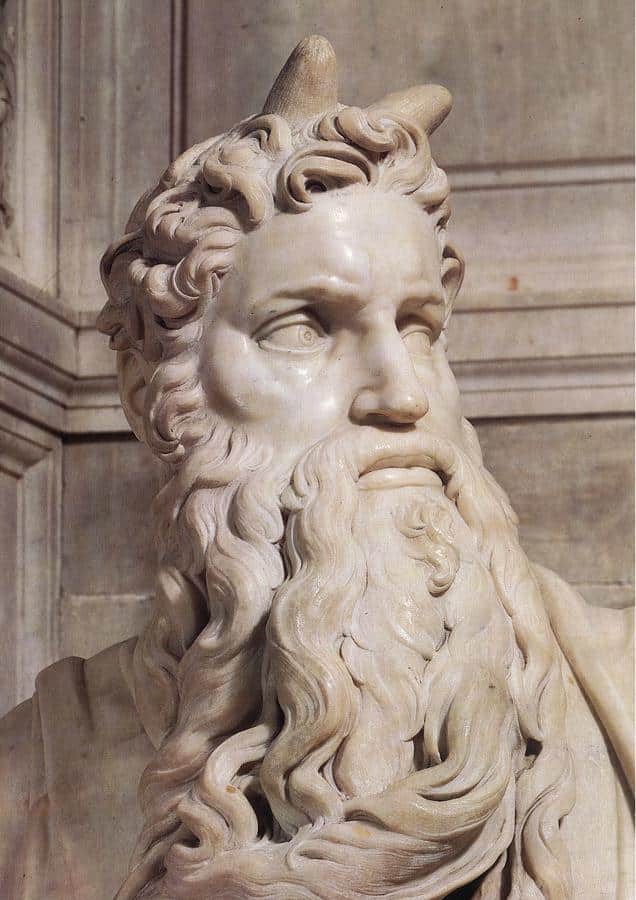
As Moses climbed down from the mountaintop with his ten commandments, the amazed Israelites noticed a great change in his appearance. The question is: did Moses have newly white hair? Or did he had a pair of horns on his forehead?
The answer to that depended on which period of history you lived in. For most of us, it's not a subject we would normally dwell on. But those who claim the Bible is the infallible Word of God, the question presents some thorny problems.
Moses with Horns
Above is a detail photo of a statue from the end of the Middle Ages. This statue of Moses was sculpted by Michelangelo between the years 1513–1515. Today, it sits in the church of San Pietro in Vincoli in Rome.
You might see something a bit peculiar if you study the photo closely. Along with his flowing beard and tablets in his arms, the Prophet Moses has a pair of goatish horns on his head.
One could be forgiven for thinking that Michelangelo was shooting at a statue of Lucifer.
But no, that's the Hebrew lawgiver Michelangelo carved.
One could be forgiven for thinking that Michelangelo was shooting at a statue of Lucifer.
But no, that's the Hebrew lawgiver Michelangelo carved.


