by Nomad
 In the previous installment in this series, we examined how the a progressive president's wife, a black workers' union and an imposed reform of the armed forces all combined to helped to jump-start the civil rights movement in the US. In the final part of our series, we will show, how a military president from the Republican Party took a very different view.
The Little Rock Crisis and Why Eisenhower Intervened
For moderate Republicans,
President Dwight D. Eisenhower is the one president - outside of
Theodore Roosevelt- that they can point to as in any way, reformist. They tend to cite Eisenhower's stand on ending segregation in the South as proof that he was committed to equality for the races and progress in general.
Despite evidence that Eisenhower was a moderate, the part he played in the story of civil rights was much more of a result of his military background, rather than a question of morality or an appreciation of fairness for African Americans.
It was actually a matter of proper organization.
When we look a little closer, we see that Eisenhower's attitude toward integration was much more ambivalent than it is commonly painted. Scholars still debate how firm his commitment was to civil rights.
It is true that he signed
civil rights legislation in 1957 and 1960, but he was overly-enthused about having to deal with racial issues.
He never endorsed the Supreme Court’s ruling in 1954, Brown v. Board of Education (Kansas), that racially segregated schools were unconstitutional, and he failed to use his moral authority as president to urge speedy compliance with the court’s decision.

Claiming states' rights, many governors, and legislatures, particularly in the South, refused to recognize the SCOTUS decision.
It was clear that the some politician leaders were ready to rebel, and they planned to use the state militias to protect their state's rights.
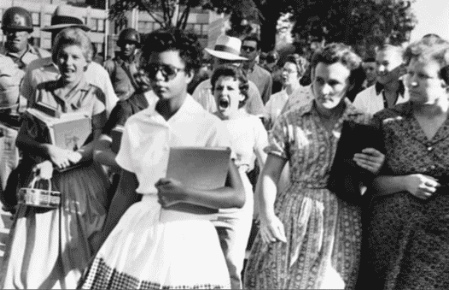
In the autumn of 1957, the epicenter of this battle of wills became Little Rock when
Governor Orval Faubus of Arkansas announced his absolute refusal to comply the court's ruling.
While the Fayetteville, Charleston, and Hoxie school districts integrated without incident, the attempt to desegregate Little Rock Central High School in the fall of 1957 led to a crisis, as Faubus tried to block the attempt to integrate the school by nine black students (the “Little Rock Nine”).


 In the late 1990s, Ken Starr was a name on everybody's lips. This was the independent prosecutor whom the Republicans hoped would derail the Clinton presidency.
 In the previous installment in this series, we examined how the a progressive president's wife, a black workers' union and an imposed reform of the armed forces all combined to helped to jump-start the civil rights movement in the US. In the final part of our series, we will show, how a military president from the Republican Party took a very different view.
 Claiming states' rights, many governors, and legislatures, particularly in the South, refused to recognize the SCOTUS decision.