Tuesday, January 21, 2014

Why Rand Paul's Lawsuit against Obama Administration on Spying Could Backfire on the GOP

by Nomad

Exclusive: Rand Paul's latest gimmick about suing the Obama administration over NSA surveillance operations, like PRISM might just backfire.  A thorough review of the legislation of Congress during the Bush era and the mixed messages from the Republican conservatives ever since 2001 could be a major humiliation in the 2014 election year.  But only if American citizens genuinely care about the truth.

The other day Senator Rand Paul of Kentucky announced that he was planning to open a class-action lawsuit against the Obama Administration over the NSA data-collection policies. Never one to miss an opportunity to make an issue into a spectacle, Rand told reporters that people needed to tell the government that it can't have access to emails and phone records without permission or without a specific warrant.  The folks at Brietbart.com and Fox News went all starry-eyed at the news:
This allows the American people to join together in a grassroots manner against President Obama’s NSA for the first time in the legal system, as all other lawsuits have been individuals suing against the agency.
The irony about it is that a quick glance at history will show us that Rand really needs to turn his attention to his own party -even to his own state. The answer to who relaxed the existing (though inadequate) oversight over the NSA is right under Rand's nose.

The Patriot Act and FISA
In the hysteria that followed the terror attacks on New York and Washington in 2001, Americans were more than ready to accept radical measures to thwart further attacks. What resulted was The Patriot Act. How this constitutionally-questionable legislation was ever passed into law reveals so much about how the Bush administration was able to achieve its goals. The techniques used would be used time and time again, right up until the end with the emergency Troubled Asset Relief Program (TARP) bailout.

On October 23, 2001, just over a month after the September 11th attacks, (actually only 25 working days) Republican Rep. Jim Sensenbrenner introduced H.R. 3162 (later to be known as The Patriot Act ) on the House floor. 
In just two days, the bill passed both the House (357 to 66) and the Senate (98 to 1) and was signed into law by President Bush on October 26, 2001.  Thus, one of the most controversial pieces of legislation, one that gave unheard of powers to the executive branch and one that effectively shredded long cherished rights in the Constitution, was passed into law in just three days. 

Monday, January 20, 2014

Christian Family's Special Message: We aren't ALL like that!

by Nomad

We interrupt our normal broadcasting to bring you this message from the Lord family from Memphis, Tennessee. 


Of course, the sad truth of the matter is that as long as Christians like this remain silent, it's only natural to think that the Westboro Church,  Tony Perkins, Pat Robertson and groups like Focus on the Family and American Family Association are the actual representatives of the Christian faith. Of course, I have met a lot of Christians in my life and the majority were quiet, down-to-earth types, wishing no harm on anybody as far as I could see. It's the loud ones you have to be wary of, I guess.


__________________________

Friday, January 17, 2014

Sequester Cuts and Killing Unemployment Benefit Extensions: When GOP Values Make no Sense

by Nomad


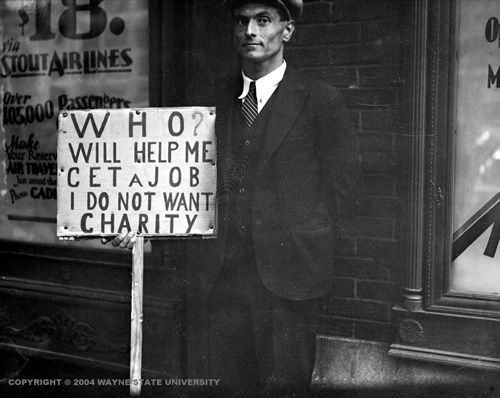
This week the Republicans appeared to be sticking to its tried and true conservative principles by blocking a vote on extending unemployment benefits. 
Add to that the impact of sequester cuts to state jobs training programs and you have a campaign issue nightmare. The question is: can any party get elected by hurting its most vulnerable voters? 
Not once but twice?

Two days ago, Republican conservatives used the power of the filibuster to block a Democratic bill to restore unemployment benefits to over a million Americans, hit hard by the recession. According to an announcement of this decision, the lawmakers declared they were standing on conservative principle.
Sen. Richard Shelby (R-Ala.) stated:
"People, if you pay 'em for years and years, they won't look for a job." 
Who is the "'em" and who are the "they"? What happened to "us" and "we"? 
Extending unemployment benefits, he added, creates no jobs. At a cost of $6.4 billion, the cost of the extension could not be justified, according to the Republicans. Shelby told an interviewer,
"That is a huge expenditure. What we need to do is spend that money on retraining these people that are unemployed -- help them for a few months and get them retrained and get them back in the job market. That's the problem."
As we shall see, there is a major problem with that idea. 
Other Republicans cited their conservative principles to support the filibuster. Senator Ron Johnson of Wisconsin said:
"I certainly ran because we're mortgaging our children's future. We're bankrupting this nation."
It's not hard to imagine the possible fallout from this decision come election time. With more than.1.3 million people Americans left without any kind of safety net nationwide, it could make a difference who controls the houses of Congress.

Wednesday, January 15, 2014

Oklahoma Federal Judge Delivers Yet Another Blow against Same-Sex Marriage Bans

by Nomad

Across the nation, state-by-state same-sex marriage bans are being overturned by federal justices. Yesterday it was Oklahoma's turn. The governor of that state has invested a lot of political capital in attempting to stop marriage equality for gay Oklahoma couples. Has Conservative governor Mary Fallin's crusade finally come to the end? 

In what campaigners for marriage equality will see as a victory a federal judge ruled on Tuesday that an Oklahoma law limiting marriage to heterosexual couples violates the U.S. Constitution. The judge ruled that Oklahoma’s constitutional amendment violates the Equal Protection Clause of the Fourteenth Amendment to the U.S. Constitution. The Fourteenth Amendment has been the basis for most civil rights legislation since it provides that no state shall deny to any person within its jurisdiction the equal protection of the laws. (This is, incidentally, the basis for corporate personhood.)

Oklahoma now joins California, Connecticut, Iowa Massachusetts), New Jersey, Utah and New Mexico where courts have ruled against same-sex marriage bans. A further 8 states have voted for recognition by legislative action and 3 more by popular vote.
By any measure, it has been a political disaster for conservatives. 

Governor Fallin
And a costly one for political groups. Millions of dollars have been spent by conservative Christian organizations like The Arlington Group to pass same-sex marriage bans in 13 states. Today there are 17 states that legally recognize same-sex marriages and that number will undoubtedly continue to rise.

Oklahoma Governor Fallin: Flailing and Failing 
This will come as a blow to many conservatives in the state who have politicized the issue. For example, Oklahoma Governor Mary Fallin had taken an active role in the matter since taking office. As if Oklahoma has absolutely nothing else to worry about.

In November, in order to stop same-sex couples from receiving benefits, she ordered the Oklahoma National Guard to stop processing benefits for all service members regardless of whether they are same-sex or opposite-sex. She told reporters that the reason for this was purely legislative. 

Tuesday, January 14, 2014

Recess Appointments and Partisan Obstructionism: Two Sides of the Same Coin

Courtsby Nomad

This week the Supreme Court is reviewing a lower court's decision which declared unconstitutional President Obama's use of recess appointments.

The ramifications of a Supreme Court decision upholding the lower decision could be disastrous for Obama. Why? Should the Senate fall into the hands of the obstructionist Republicans, Obama's chances of getting any nominations may be impossible. How the justices decide in this case could play a crucial factor not only in the remainder of this administration but in future presidencies.


Recess Appointments
Like a lot of cases before the Supreme Court, the actual importance and impact are buried beneath mounds of mundane details. Such is the case of the constitutionality of recess appointments. For instance, strictly speaking, the case is straightforward. It revolves around the president's ability to make appointments while the Senate is at recess. What are the limits to this presidential power according to the constitution? 

There is no reason question whether the US constitution gives Presidents the right to fill a vacant position if the Senate is in recess. Wikipedia describes recess appointments this way:
The U.S. Constitution requires that the most senior federal officers must be confirmed by the Senate before assuming office, but while the Senate is in recess the President may act alone by making a recess appointment to fill "Vacancies that may happen during the Recess of the Senate."   
In a happier world in which all of the branches of government work together and make nice to one another, this could be seen as merely a way to smooth the confirmation process along. But of course, that's not the world in which we live and Washington has never a happy place for long. 

Sunday, January 12, 2014

Waiting for America's Bhopal: How Budget Cuts and De-Regulation Are Making the Unimaginable Inevitable

by Nomad

Last year's West, Texas explosion and this week's West Virginia chemical leak could just be a wake up call to the nation. De-regulation and budget cutting may make us more competitive but at what cost?

A single environmental disaster could affect the lives of millions of people, cost the state billions and make entire areas uninhabitable. And that  could make the discussion of de-regulation and budget-cuts completely null and void.

Not long ago I read the book Five Past Midnight in Bhopal: The Epic Story of the World's Deadliest Industrial Disaster. It's the kind of book that you know you should read but dread to begin. It's an exceedingly thoroughly-researched book and at times, slow going. In spite of that,  in these days when environmental regulations are under attack by the conservative Republicans, it should be on every American's reading list.

Most people, I suppose, have heard of the industrial disaster at Bhopal but here's a little refresher.

The Bhopal Event
In the early hours of December 3, 1984, in the town of Bhopal, India, a nearby Union Carbide plant, which manufactured insecticides, accidentally released a heavy toxic cloud of chemicals into the surrounding residential area. The heavy cloud hovered over the area, which was comprised mostly of crowded slums. It literally fumigated the unsuspecting village, mercilessly killing the people that lived there.

Within hours, things quickly collapsed. Panic and confusion spread and any kind of coordinated response was impossible. The local government was totally ill-equipped to handle the emergency. (The very idea that it could happen at all seems never to have crossed their minds.)