Nomadic Politics travels to the Caribbean to report this story about how a family squabble has left one dead millionaire on ice since before Obama became president.
Here's a small story that caught my attention.
According to an article in the Jamaican Observer, seven years have passed since an unnamed local man died and yet today his body is still being kept in storage at a downtown Kingston funeral home.
To top it off, even now, nobody is quite sure when the man will ever be properly interred.
The reason?
An ongoing dispute about money between family members.
Mr. Michael Jones, the director of the funeral home, says he has run out of patience. After waiting since 2007, he is now is threatening to take legal action against the family to recover millions of dollars, he says, he is owed for storage fees.
Back in 2007 things seemed to be going smoothly. After the initial negotiations the discussions with family members seemed to finalize things, claims Jones, But then, there was some kind of problem. According to Jones, the family suddenly became unable (or unwilling) to bring him the necessary documents and payments to allow him to proceed with the burial. And that's how things have stood since that time.
Jones claimed that, at the time, family members requested that the man be buried and promised that payments would be made at a later date. But he said he refused to do that.
The funeral director says that in more than 20 years of business, he has never seen anything like this. He has encountered similar cases in the past where people were unable to pay for the costs. And obligingly- though probably not happily, he has in the past offered to write off the expenses. It's one of the things that comes with the job.
However, this case, he claims, is quite different.
In Part 1 of this series we examined how and why President Nixon declared his war on illegal drugs. However, the public learned the moral crusade was being led by a president with dubious moral qualifications.
In the second part of the series we carry on the story with the Ford Administration's efforts to make sense of Nixon's policy.
That wasn't going to be easy.
Part 2. The Flaw and the Irony
Ford's Challenge
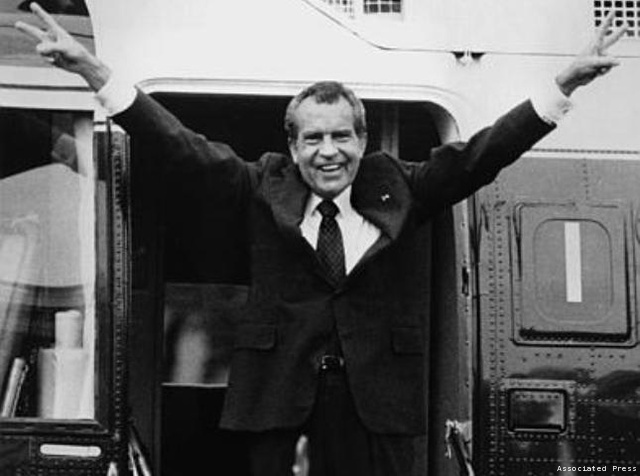
In 1974, with a hearty arm wave from the doors of a helicopter, disgraced President Richard Nixon bid farewell to power. The anti-drug warrior was immediately replaced on August 9, by America's first and only unelected president, Gerald Ford. (In less than a year, Ford had gone from congressman to vice-president to president.)
The Watergate investigation- as it turned out- was just the beginning of the government's distress. If the new president was calling for a "Time of Healing" it was soon clear that some people were not going to let the house cleaning end with Nixon.
In January 1975, the Church committee, an independent investigation was established by Senate and continued the post-Watergate housecleaning. The target was no longer the president and his staff but CIA and claims of grievous misconduct, The committee's investigation pulled back the cover on such things as assassination attempts against foreign leaders, covert attempts to subvert foreign governments and the FBI and CIA’s efforts to infiltrate and disrupt organizations here at home. (That's just the short list.)
Senator Church, after reviewing the evidence of widespread abuse by the FBI, CIA, IRS and NSA, called the intelligence agencies "rogue elephants."
The investigation dragged on throughout most of Ford's time in office, and involved testimony from highest levels in the intelligence community.
Under those circumstances, any attempt to restore the stability of the nation was going to be a challenge. Nixon's drug war was just another example of the general chaos in government of that time. And much of the problem, the confusion, centered on the policy stance on marijuana.
The number of Syrians fleeing the hell of civil war is staggering. As Syria's neighbors are struggling to keep the situation under control. Still, the costs and tensions continue to rise. Just keeping the thousands fed, sheltered and protected is becoming more and more of a burden. But, as bad as they are, things could soon become worse.
Unless additional funding is found, Amos declared, the program would be closed within two months.
The WFP announced in the middle of September that it would reduce its food supplies to around six million Syrian refugees due to a shortage of funds, reiterating the need for an additional $352 million in support before the end of 2014.
Al-Quds newspaper quoted Amos as saying that the WFP has already reduced the portions of food aid in order to stretch them as far as possible.
Amos also pointed out that an estimated 600,000 Syrians in the east, in Deir Al-Zour, and north, in Al-Raqqa, have been unable to get food aid for the third month in a row, due to the on-going violence.
The timing couldn't be any worse. Amos warned:
"Winter is coming and basic items are urgently needed in order to help protect people from the cold."
For people who have had to endure a blistering summer with temperatures staying in the triple digits for months, a cold and wet winters will be just another test of endurance, some weary refugees will be facing.
Last December, camps in Lebanon and Jordan were dealt a little more misery, with below-freezing temperatures, torrential rains, and unusually severe snowstorms, The best aid agencies could do for the tent-city residents was to distribute plastic sheeting and tarps. Conditions in Lebanon were particularly appalling.
Taking a more clinical view, without adequate medical care, these camps will become the perfect breeding ground for epidemics. which could easily spread to host countries.
The Syrian refugee crisis has become the worst humanitarian crisis with one of the largest forced migrations of people since World War II. According to reports, there are an estimated 9 million Syrians that have been forced to flee their homes region, since the civil war began in March 2011.
Roughly 2.5 million have fled to Syria's immediate neighbors Turkey, Lebanon, Jordan and Iraq. with the rest have been internally displaced inside Syria.
American exceptionalism is a useful tool when it comes to claiming the higher moral ground. However it comes with serveral pre-conditions and mandates. One of those is a higher sense of moral development. We must be -at least in some way- a bit better.
However, when it comes to our treatment of the homeless, the elderly, the sick and the need, where is our moral superiority?
The great can protect themselves, but the poor and humble require the arm and shield of the law.
Back then, it was like stating the obvious.
Over a hundred and fifty years later, in November 1977, former Senator and vice-president. Hubert Humphrey said:
"..The moral test of government is how that government treats those who are in the dawn of life, the children; those who are in the twilight of life, the elderly; and those who are in the shadows of life- the sick, the needy and the handicapped."
If, as one philosopher said, compassion is the basis of morality, then what does it say about the present state of morality in government today.
Has our government passed that moral test?
Is that even a criteria for public policy anymore?
When did it stop being important?
When Charity is a Crime
Thirty-three US cities have enacted policies banning the feeding of homeless. Daytona Beach, Florida, Raleigh North Carolina, Myrtle Beach, South Carolina and Birmingham Alabama have all recently fined, removed or threatened individuals and private organizations found breaking the laws.
As one source notes:
According to a report co-released by the National Coalition for the Homeless and the National Law Center on Homelessness & Poverty, during the past seven years Gainesville, Fla., began “enforcing a rule limiting the number of meals that soup kitchens may serve to 130 people in one day;” Phoenix, Ariz., “used zoning laws to stop a local church from serving breakfast to community members, including many homeless people, outside a local church;” and Myrtle Beach, S.C., “adopted an ordinance that restricts food sharing with homeless people in public parks.”
In a Daytona Beach incident, a couple who ran a Christian outreach group for over a year were fined for giving free food to the homeless.
In all, police officers ticketed six people, including four volunteers who helped the Jimenezes on Wednesday – one of them, a man in a wheelchair who recently escaped homelessness and participated “to pay it forward,” Debbie Jimenez said. The fines levied by authorities total $2,238.
Police officers also warned that all members involved were permanently banned from the park. If they ignored the warning they would be arrested for trespassing — on public property, no less. As one reporter said, "The right to peaceably assemble has been declared null-and-void for charity workers."
The excuse the officials gave was that not all of the homeless people are mannerly or clean while in the park. Living on the street tends to take the GQ and Gucci out of its victims. They also point out that some homeless people have mental health issues and substance abuse problems and criminal records.
It's an ironic statement, as we shall see.
Charity has always been considered one of the fundamental virtues of the Christian faith. Famously, the New Testament in the Gospel of Matthew relates the parable of the good King who admonished his ministers for their pettiness and selfish.
‘Truly I tell you, whatever you did not do for one of the least of these, you did not do for me.’
The punishment for helping only the well-off and powerful to the determent of the needy? The King cursed them, "into the eternal fire prepared for the devil and his angels."
Pretty harsh.
Both St. Augustine and Thomas Aquinas wrote that charity united us to God and that the habit of charity extends not only to the love of God but also to "the love of our neighbor."
Many Christians would say that love for your neighbor- whether rich or poor- is the key principle of the religion and any law that forbids individuals from assisting the needy is, in fact, anti-Christian.
However, it appears that the same people who claim that America is a Christian nation are quite comfortable with outlawing feeding the hungry and helping the needy. They must be too busy fighting for their religious liberty not to bake cakes for same-sex couples.
Criminalizing the Homeless
If that were the only laws that made things difficult for the homeless, it would be shameful enough. But sadly, that's only the tip of the iceberg.
In Houston, it has become illegal to search in dumpsters for food, as so many homeless people are forced to do. One 44-year old homeless man was ticketed by a Houston police officer for." disturbing the contents of a garbage can in (the) downtown business district."
In the Houston area, the most recent statistics indicate that more than 6,300 people are without a home on any given night. Nearly half of the unsheltered homeless population have a mental illness and/or substance abuse disorder. (There is good news too. Since 2011, there has been a 37% decrease in homelessness in Houston and in the past year, an impressive 16% decrease, according to the Coalition for the Homeless of Houston/Harris County.)
In San Francisco, arrests for illegal lodging, or sleeping outside are increasingly common citywide. According to one source,
The number of such citations of homeless people jumped sharply in the last two years: Illegal lodging charges increased from 85 to 219; maintaining a public nuisance, from 134 to 240; and obstructing a sidewalk, from 317 to 677.
Said Elisa Della-Piana, director of the Neighborhood Justice Clinic in Berkeley explained to T.J Johnston, writer for Street Spirit:
“A tired homeless man faced up to three years in prison for dozing off on a milk crate. Prison. For sleeping while sitting up — an act that anyone who has ever been on a plane ride can attest is torture in and of itself.”
Increasing the penalties against the homeless only punishes the ones who need help, especially after deep cuts in affordable housing and "other poverty-abatement programs starting in the 1980s."
Origins of Our Contempt
According to the nonpartisan think tank, The Urban Institute, between the years 1981 and 1989, the homelessness rate tripled.
One reason for this was the lack of affordable housing. Available housing for the low-income household became harder and harder to find. There was a reason for that.
In the effort to limit government responsibility- a prime directive for conservatives- the budget for Housing and Urban Development (HUD) was cut by a staggering $65 billion, going from a budget of $83 billion in 1978 to only $18 billion in 1983.
In effect, as one source put it, the federal government under Reagan "relinquished its responsibility for developing affordable housing for low-income families."
For an explanation of the full effects of the policies, you can go to this informative site.
Consider that during the same years, Congress was debating the Reagan budget of the B-2 stealth bomber. At $2.4 billion each, Congress cut its initial purchase of was 132 bomber to just 21.
If nothing else, this gives some indication of the moral priorities.
Another of Reagan's policies which contributed to the rise of homelessness concerned the governmental responsibility of the mentally ill (including substance abuse.)
Combined with a sharp rise in homelessness during the 1980s, Ronald Reagan pursued a policy toward the treatment of mental illness that satisfied special interest groups and the demands of the business community, but failed to address the issue: the treatment of mental illness.
Betraying our Duties
Upon closer inspection, we can see that the movement that put more and more mentally ill patients on the street did not begin with President Reagan.
It was actually a part of the 60s and 70s reforms that gave more rights to patients with treatable mental illness. Drugs were seen as the panacea for mental illness and policy-makers with doctors decided that the best course was to put the less severely patient back into the community. It was a major mistake.
The range of patients who could be released into the community - so long as they were not a threat to others- broadened considerably.
The effect was predictable: Once released, they would fail to take meds or get counseling and went right back to being seriously ill. As reported back in 1984, the policy was not working and something needed to be done:
Dr. Frank R. Lipton and Dr. Albert Sabatini of Bellevue Psychiatric Hospital in Manhattan, who have done research on the problems of the homeless, say one of the major flaws in the concept of deinstitutionalization was the notion that serious, chronic mental disorders could be minimized, if not totally prevented, through care provided within the local community.
The neo-conservative mandate under Reagan to slash government programs all but ensured that Federal funds for community mental health programs would begin to dry up, shifting the burden to the states. The states, in turn, followed the federal government's lead and legislators too cut their budgets on mental health programs.
It was more than any single Reagan policy. It was a general attitude that homelessness, unemployment, substance abuse, and even diseases like AIDS, were all personal problems and that governments had no mandate to seek resolutions. In short, social problems could and should be resolved without any cost to government.
It may surprise a lot of the young whippersnappers that at one time when it came to helping the homeless, it was a matter of national pride. Edward Kennedy in his 1980 concession speech at the Democratic convention said:
Our commitment has been, since the days of Andrew Jackson, to all those he called "the humble members of society.." On this foundation we have defined our values, refined our policies and refreshed our faith.
And that was the historical pivoting point.
By electing Ronald Reagan in 1980, Americans decided by popular vote to turn their backs on the poor, the drug addicts and the mentally ill. The road to prosperity had to have its scapegoats, after all. The humblest members of society didn't deserve our attention. There had to be winners and losers.
What was the joy of success if prosperity was to be universally shared to all members of society?
When Compassion Became a Joke
Nobody can claim ignorance about Reagan's record. His sense of empathy had been made clear for years, well before he was elected president. In 1966, before a TV audience he said:
"We were told four years ago that 17 million people went to bed hungry every night. Well, that was probably true. They were all on a diet."
Hunger in America, for many, was just a joke.
When heiress Patty Hearst was kidnapped and the SLA- the group that abducted her- initially demanded that free food for the poor and elderly be distributed in the poor neighborhoods of San Francisco. It was, they said, a condition of beginning negotiations for the release of Miss Hearst. In three days of distribution, over 75,000 resident received food through charity organizations.
What was Governor Reagan's response?
Reagan told reporters that people who accepted the food were "aiding and abetting" felonies. (I am sure he meant felons, not felonies.) He said he "deplored the fact that these people are accepting the food."
Fuming at the hostage-takers' demand, Reagan reportedly told Republicans at a luncheon (a luncheon!)
"It's just too bad we can't have an epidemic of botulism."
(He later claimed the botulism remark was just a joke.)
Joke or not, sometimes an off-hand remark can reveal so much about the character and the moral standards of the teller. President Reagan and the party that has always held him in high regard- indeed idolized him- set the path that would today lead to laws making the poor and the sick and the homeless criminals.
For a nation that takes so much pride in its Judeo-Christian roots, -with a moral code that demands we treat others the way would expect to be treated, that teaches us to care for the needy and the helpless as a glory to God- you'd think we could treat the homeless just a little bit better than this.
As more and more reports come in about the benefits of Obamacare, governors of Red States, some analysts predict, are soon going to feel the heat from the miffed voters.
Few could call Forbes a flagship of the liberal press so when it posts a negative article against conservative policy, it must send a few night-terrors into the sleep of Republicans.
Good News and Bad Tidings
Last week, for conservatives, Forbes was the bearer of bad tidings. Obamacare isn't so bad after all. and as the article says, for the governors of red states who had once been so quick to reject the Medicare expansion, things are going to get a little worrisome.
A new report showing the continued pileup of unpaid medical bills in states that didn’t expand Medicaid under the Affordable Care Act is escalating criticism on these Republican-led areas of the country to expand the health insurance program for the poor.
True, the report did come from the Obama administration who- conservatives would say- would have every reason to paint a rosy picture. Yet, sooner or later, the facts will spill out one way or the other. And the Obama administration's figures were bound to come under close scrutiny.
The fear-mongering of "death panels" was well-financed, well-promoted poppycock for the low-information, hate-driven voter or the perpetually gullible.
Turkey's long-standing headscarf ban has been the bane of conservative religious groups for years. The ruling party has just issued a new dress code for public school students which will finally see the end of the ban. Here's why a lot of people aren't very happy about the new dress policy.
To understand the news about Turkey's headscarf controversy,
it is helpful to realize how important symbolism can be. Especially the religious kind.
Back in the 1920s, when Mustafa Kemal established the modern Turkish Republic from the ruins of the Ottoman Empire, he was determined to break with the theocratic tendencies of the past.
The so-called "Father of the Turks" believed the excessive influence of religion in all aspects of life, but especially in politics and in state affairs had led only to backwardness. Secularism, Kemal believed, was the solution.
In his effort to set up a secular forward-thinking republic, he banned most of the articles of religious symbolism, like the wearing of the fez and beards for men and the Islam-mandated covering for the women. In all public buildings and government schools, fezzes and headscarves were formally banned.
(If that sounds incredible or high-handed, remember this is a man who changed the Turkish alphabet from Arabic script to Latin letters practically overnight.) Until the religious-based AKP party took the reins of government, that ban had gone unchallenged.
The Headscarf Cultural War
Like all government workers, public school teachers and students were forbidden to wear headscarves in school. In the private sector had for the most part followed suit with its employees.
For religious conservatives this headscarf ban has long been a thorn in the side. They have successfully defeated the ban. And they couldn't have done it without the help of Europe.
The mid-term elections that put the Tea Party in Congress was real-life demonstration of Plato's observation. The question is whether American voters are still as apathetic as they were then.
The city of Birmingham, Alabama is trying out an urban project to bring healthy food to neighborhoods in need.
In
past blog posts we have taken a look at the problem of "food deserts." Where deserts are places with limited water or limited access to whatever water is there, food deserts are areas where residents may not have access to affordable and healthy food
options.
That's particularly true when it comes to the healthy alternatives (fresh fruit
and vegetables).
According to a report prepared for Congress by the Economic Research Service of the US Department of Agriculture, about 2.3 million people (or 2.2 percent of all US households) live more than one mile away from a supermarket and do not own a car.
There's no mistaking it. The problem cuts down racial and class lines. Food
deserts can be most generally found in communities of color and low-income
areas (where many people don't have cars).
In contrast, wealthier parts of town, studies tell
us, have three times as many supermarkets as poor areas. And white
neighborhoods have on average up to four times as many supermarkets as black
neighborhoods. To make matters worse, grocery stores in African-American
communities are usually smaller with less selection.
It's
only a slight exaggeration to say that in some poorer sections of urban America, it could be
easier to buy illegal drugs than to find a healthy meal for a family.
So, that's the problem, but
what are the solutions?
Birmingham's Bright Idea
Well, the city of Birmingham, Alabama has approved of a innovative plan to bring the food to those who most need it.
The other day, Donald Trump accidentally revealed his shocking ignorance of the US political system. It shouldn't have surprised anybody.
Despite all of Trump's self-aggrandizing boasts, the real question is why anybody in their right mind would take his advice about anything.
Whom Trump Really Loves
When mogul Donald Trump endorses his favorite politician it must be a very a mixed blessing and a dubious honor to be the object of his affection. If Mr.Trump loves anybody in this world (and that's iffy) it is only Donald Trump. A Trump endorsement serves only one purpose: to attract much more attention to Trump.
In the case of Senator Mitch McConnell, Trump managed to turn the benefit of a high profile endorsement into just another case of Trump making a jackass of himself before the whole dang world.
Trump's obvious attempt to slag McConnell's challenger, Democrat Alison Lundergan Grimes, spectacularly backfired the other day. Trump tweeted:
Unfortunately, for Trump (and the rest of the nation) McConnell is a Senator, not a Congressman, as Trump seems to think. Somebody should have told Trump that Congress is composed of two houses of Congress and .. oh, never mind, Trump would have probably nodded his frizzy uncooperative head, blinked back and fired an unpaid intern.
The problem is that it's so much harder to blame your underlings when you have tweeted something awfully dumb like this. (Rick Perry just said his stupid tweet was "unauthorized" and left it to our imaginations.)
What kind of excuse can he make for his obvious ignorance about the fundamentals of US politics? On the other hand, Trump has never let stupid mistakes or dumb remarks (or bad hair days) stop him plowing on towards the next dumb thing.
Trump loves to dole out sage advice. It makes him seem important. He thinks. Mr. Trump spends all day thinking up precious gems like this:
Part of being a winner is knowing when enough is enough. Sometimes you have to give up the fight and walk away, and move on to something that's more productive.
In fact, this could be perfect advice to give Senator McConnell.
Being a winner is something that Trump pretends to know all about but in fact, his record isn't particularly impressive.
A Florida case poses the question: What happens when the First Amendment rights of an employee comes into conflict with the corporate free speech guaranteed by the Citizens United decision?
Is it legal for an employer to fire workers who campaign against their corporate-supported candidate?
Raw Story has a story about a Democratic
candidate running for Osceola County Commission who was fired for attempting to
unseat the candidate her company supports. Viviana Janer's employer, Marriott Vacations Worldwide reportedly gave her the choice of either quitting her
campaign or losing her job of 11 years.
Janer told reporters:
“After a decade of accolades and promotions, I was told my job would be abruptly terminated if I did not drop out of the race. Despite my wish to continue working, I felt I could not turn my back on the many citizens of Osceola County who worked so hard to get me elected. I refused to drop out of the race, and on Friday I was fired from a job I loved.”
According to the termination
letter from Senior Vice President and Chief Audit Executive Julie Meyer, Janer
was fired because she had not received permission to run for office.
However,
as Janer pointed out, company policy actually encourages political involvement in general.
Marriott Vacations Worldwide encourages your personal participation in elections and government processes. However, you must conduct your personal political activities on your own time and without use of the company’s resources (e.g., stationery, copying machines, or office supplies).
Once upon a time, these are the ideas that children grew up with. Yeah, it was a form of brainwashing, I suppose. But there are worse things to teach children.
Back in the 1960s, children were taught that if it wasn't always true or always true for all people then it was at least a goal for a proud and respectable nation.
I wonder what values are being instilled in children today?
I admit that I cannot verify everything on this meme, but there are plenty of good links out there (and here) that confirm enough of his background to rate him as a first-class hypocrite.
That's not to say he is not an excellent doctor but as a public figure, he is way-way-way out of his depth. This is a man who with a straight face compared Obamacare to slavery. (That's right, the whipping and chaining institution that considered men with black skin to be little better than animals or a commodity to be exploited.)
Carson also equated homosexuality to pedophilia and bestiality. and declared white liberals to be “the most racist people there are”. (That was, no doubt, a crowd pleaser for his conservatives audiences.)
Starting with President Nixon, the War on Drugs has been a series of costly mistakes. Sadly, most of the misjudgements might have been avoided if only officials had listened to the experts and to the people most affected.
Part 1. Nixon, Drugs and the Hippie Removal Scheme
Nixon and the Mandate of the Silent Majority
To understand what went wrong with America's War on Drugs, we have to go back to the days of President Nixon and the time before Watergate. In this
turbulent moment in US history, there was a fundamental difference of opinions about the causes of the upheaval in the 60s.
Taking a look at the nation in turmoil at colleges and universities, President Richard Nixon not long after taking office, said:
It's not too strong a statement to declare that this is the way civilizations begin to die... The process is altogether to familiar to those who would survey the wreckage of history. assault and counterassault, one extreme leading to the opposite extreme; the voices of reason and calm discredited.
(As it turned out, it was a oddly accurate assessment and it is even more true today than then.)
At the time many people, especially conservatives, considered the liberal policies of the 1960s, particularly, domestic programs of the Great Society, to be a failure. The Supreme Court decisions, on abortion and civil rights, combined with liberal idealism had opened a Pandora's box. That was what a lot of middle class people across the country genuinely believed.
The rebellious counter-culture, which included the hippies, the yippies, the anti-war protesters, the bra burners, the liberationists, the anarchists, the Communists, was fueled not by resentment or by anger at injustice. Drugs had to be behind it all. What else could make kids from well-off backgrounds, drop out of society, throw away all of the material advantages and live like gypsies? What else could make them so wild and violent?
That view was both widespread and often propagated by the mainstream news media. The conventional wisdom said that the widespread use of illegal drugs was just another example of the general breakdown of law and order.
Few Americans have heard of George Frisbie Hoar. This is the story of a man who, after seeing most of his country's history first-hand, had the courage to denounce its imperial aspirations. He represents, in other words, the opposite of another familiar politician of our time.
Remembering The Words, the Things He Did
On the summery Friday afternoon of June 26th, 1908, crowds gathered together in front of Worcester City Hall. Massachusetts. As if to remind everyone there that an era was passing, only a few days, the former president Grover Cleveland had died. Thoughts were therefore already on the mortality of famous men and their memorials.
The attendees had come to dedicate a statute in honor of a locally-beloved political figure who had died four years earlier. The man's name was George Frisbie Hoar, a man who had been called a "crusader for the rescue of free thought in a free land."
The dedication ceremony commenced with a prayer by the Unitarian minister, Edward Everett Hale. The crowds fell into a respectful silence. "Father of life, Father of love" Hale said, "we thank Thee for him. We thank Thee for his life."
Father, we renew our vows and promises and hopes and petitions, that we may repeat his life, in remembering the words that he taught us — in remembering the things that he did. We cannot thank Thee in words for what he did for his State and for his Country.
It was, sadly, a promise not kept and outside of that memorial, few people today have ever heard of this Republican New Englander. Admittedly, it's not a name most people today would recognize. For that reason, that memorial statute may seem as remote and as mysterious as Stonehenge.
Sad because this is a man with so much to tell us now.
His most famous speech was a condemnation of the imperialist approach to and the subjugation of the Philippines Islands. To understand that speech's importance to our time, it's essential to understand the parallels of two eras separated by a century.
If the War on Drugs has been a failure, it's time to ask what exactly went wrong. That's a question we will be taking a closer look at next week. Firstly, in this post, we will look at the scale of the problem.
I'm in favor of legalizing drugs. According to my values system, if people want to kill themselves, they have every right to do so. Most of the harm that comes from drugs is because they are illegal.
Of course, Friedman ignores the very serious consequences of drug addiction, such as wasted lives and destroyed families, the increase in crime and poverty. and generations of young people who might have contributed to society being turned into veritable zombies. Doing nothing, no matter what Uncle Milt might thing is not an viable option. In that light, Friedman's notions strikes one as being cold and pitiless.
Still there is a tiny kernel of truth buried in the idea.
If wars are ever moral in any sense, the War on Drugs was depicted in its opening salvos, as a battle of good against the evils of addiction. In fighting this particular war, however, one of the problems was understanding exactly who the enemy was and who were its victims.
Of course, it was clear something had to be done. However, at some point after President Nixon officially kicked off the War on Drugs in 1971, the anti-drug policy jumped the tracks and then coasted along with nobody at the wheel.
Today after four decades of fighting, the drug war has, at least according to one source, cost the taxpayers over $1 trillion dollars.
This may not be a big story but it's worth telling. When the residents of one Virginia town heard the call for help, they didn't think twice. For two dozen injured soldiers, the symbolism of the moment must have meant a lot.
A local radio DJ who goes by the name of Ripley was the prime mover behind the idea of
throwing a "Welcome Home Celebration" for injured servicemen, women,
their caretakers and guests. The Yellow Ribbon Fund, an organization hich supports injured vets and their families, also pitched in.
Ripley explained:
"After speaking with two of our station advertisers, one a restaurant and the other a Harley-Davidson Dealer, they threw their entire support for this event,"
Despite a lot of logistical planning, the unexpected happened. On the way to the ceremony, the bus carrying the wounded servicemen broke down on Route 205 just inside the Westmoreland County line.
What might have been a big disappointment for the soldiers and their families was suddenly turned around by the swift response of the townspeople.
No wonder there has been such a strong push of policies like Voter ID laws. Back in 2012, writer Jonathan Chait, in a New York magazine article entitled "2012 or Never," noted the phenomena of the incredible shrinking white electorate:
"Every year the nonwhite proportion of the electorate grows by about half a percentage point -- meaning that in every presidential election, the minority share of the vote increases by 2 percent, a huge amount in a closely divided country."
He adds:
"By 2020 nonwhite voters should rise from a quarter of the 2008 electorate to one third. In 30 years, "nonwhites will outnumber whites."
In controversial ruling, a federal judge struck down Wisconsin's Voter ID law. This requirement had, said U.S. District Judge Lynn Adelman, a “disproportionate impact” on African American and Latino voters.
According to a Washington Post article, eight states, mostly in the South, have similar laws as the Wisconsin law. And 31 states have voter ID laws, of one kind or another. Stricter requirement are scheduled to come into effect in the future.
A few days ago, the spotlight turned to Texas, In Corpus Christi, U.S. District Court Judge Nelva Gonzales Ramos will review a challenge to the state's laws from both U.S. Justice Department and civil rights groups.
The Republican-dominated Legislature in 2011 passed a strict Voter ID law which, for some people, made it easier to by a hand gun than to vote. Hundreds of thousands of Texan voters will be affected. The target? Students, minorities, the poor and the elderly- anybody who may not possess the proper ID required by law.
Governor Bobby Jindal recently raised a few eyebrows with some of his ideas on minorities. Some said that he was implying that ethnic minorities could make everyone a lot happier if they gave up their hyphens and became Americans. Full stop.
However, many on the Left seem to have missed what the true purpose behind the remarks.
Recently in an op-ed piece for Politico, Louisiana governor Bobby Jindal gave his ideas on the dangers of excessive emphasis on diversity and multiculturalism. The liberal press quickly jumped on Jindal's remarks, interpreting them as his desire for all minorities to be white as Wonder Bread. It was a bit unfair since he isn't actually saying that.
In fact, his words deserve a little more attention..rather than a hasty dismissal. If only to understand more fully why the ideas he expressed were so wrong.
The Threat of the Hyphen
In the article, Jindal offers a few interesting points, though most on the left would find hard to agree with. He says, for example, that minorities should pay less attention to their separateness and just try harder to become like the rest of us: American. He writes that today "we seem to act as if that melting pot is passé, an antiquated notion."
Yet we still place far too much emphasis on our “separateness,” our heritage, ethnic background, skin color, etc. We live in the age of hyphenated Americans: Asian-Americans, Italian-Americans, African-Americans, Mexican-Americans, Cuban-Americans, Indian-Americans, and Native Americans, to name just a few.
Jindal also leaves out a very important minority in his list. Jewish-Americans? It is an understandable omission for a Republican. Let's see Jindal speaking before B'nai B'rith, telling the Jewish audience that they need to drop their Jewish heritage and see what happens. They would, with justification, be outraged. Still, it would be a lovely way for Bobby Jindal to immolate his political aspirations.
Incidentally the term "melting pot" was coined by Israel Zangwill, a child of Jewish immigrants from Czarist Russia. Although he, like Jindal, felt all races and cultures could come together to make the American identity, he was also an early Zionist, an proponent for the creation of a state for Jews and for Jews alone. So even he, like Jindal, had some contradictory ideas.
Two seemingly-unrelated situations involving free speech, come together in this post to expose America's first amendment hypocrisy.
Most of us know that free speech is not absolute. But why should some forms of free speech be restricted except when it comes from religious leaders? Why only Christian leaders? Why is hate speech allowed to hide behind the shield of religious liberty?
Often you'll see news stories and you think, there has to be more to this. If you take it a face value then the whole thing is just too stupid / ridiculous / scary to be believed. Or, at least, you don't want to believe it could happen in the US. Here's an example of what I mean.
The Evans Case
According to a local news channel, a 31-year-old Muhlenberg County, Kentucky man posted heavy metal song lyrics on his Facebook account on August 24th and three days later, James Evans was charged with "terroristic threatening.”
On Wednesday last week Evans was finally released on bail after spending a full eight days in jail. He has been told the case would be deferred for six months and he would have to undergo a mental evaluation.
The
article quotes Mike Drake, the Muhlenberg County school resource officer, explaining
that multiple agencies received calls concerned about the post. Other than
that, the county attorney and the school resource officer for the Muhlenberg county
schools have declined to comment about the Evans case.

 Nomadic Politics travels to the Caribbean to report this story about how a family squabble has left one dead millionaire on ice since before Obama became president.